Propose joint-action changes
CEM samples changes to the G1 controller’s 29 joint targets. Simulated outcomes rank these proposals, and the strongest candidates guide the next round of sampling.
Eliciting Contact-Rich Out-of-Distribution Behaviors from Pretrained Humanoid Controllers
LJS discovers new physical interactions by mapping joint-action proposals into a frozen controller’s latent space and evaluating their effects in simulation.
New
Can what LJS discovers become a controller for a real robot? We gave it a new task, a Unitree G1 climbing onto a 0.75 m table pushed against a wall and standing on it, and trained a closed-loop policy from a single CEM-LJS rollout. Writing the physical effects, searching and training took 3 to 4 hours in total.
The policy uses only what the robot measures itself: its IMU, its joint encoders, and the edge of the table as seen by its head camera. It climbs onto the table and stands up in 96% of 512 simulated trials, with the table’s position, height and friction, the robot’s motor gains and masses, and every sensor reading randomized. It also carries over without retraining to a second simulator, standard MuJoCo, where it climbed and stood on all 48 randomized tables we tried. That is the engine running the live demo below.
Pick a table, deploy the policy and watch it climb. The physics and the policy both run live on your device, with nothing prerecorded. The policy sees only what the real robot would.
Load the simulation to begin.
The sliders cover the ranges the policy was trained on. Drag to orbit the camera.
Hardware demonstration coming soon.
Using LJS, a frozen BFM-Zero humanoid controller traverses a hurdle, lifts and passes beneath a shutter, and opens a door with a carried cube. These behaviors are discovered through simulator search, without task-specific policy training or reference motions.
Joint-action perturbations provide a direct way to express local control changes, while latent commands retain the structure of the pretrained policy. LJS connects these spaces through a damped local inverse of the policy Jacobian, allowing search in joint-action coordinates while executing through the frozen controller.
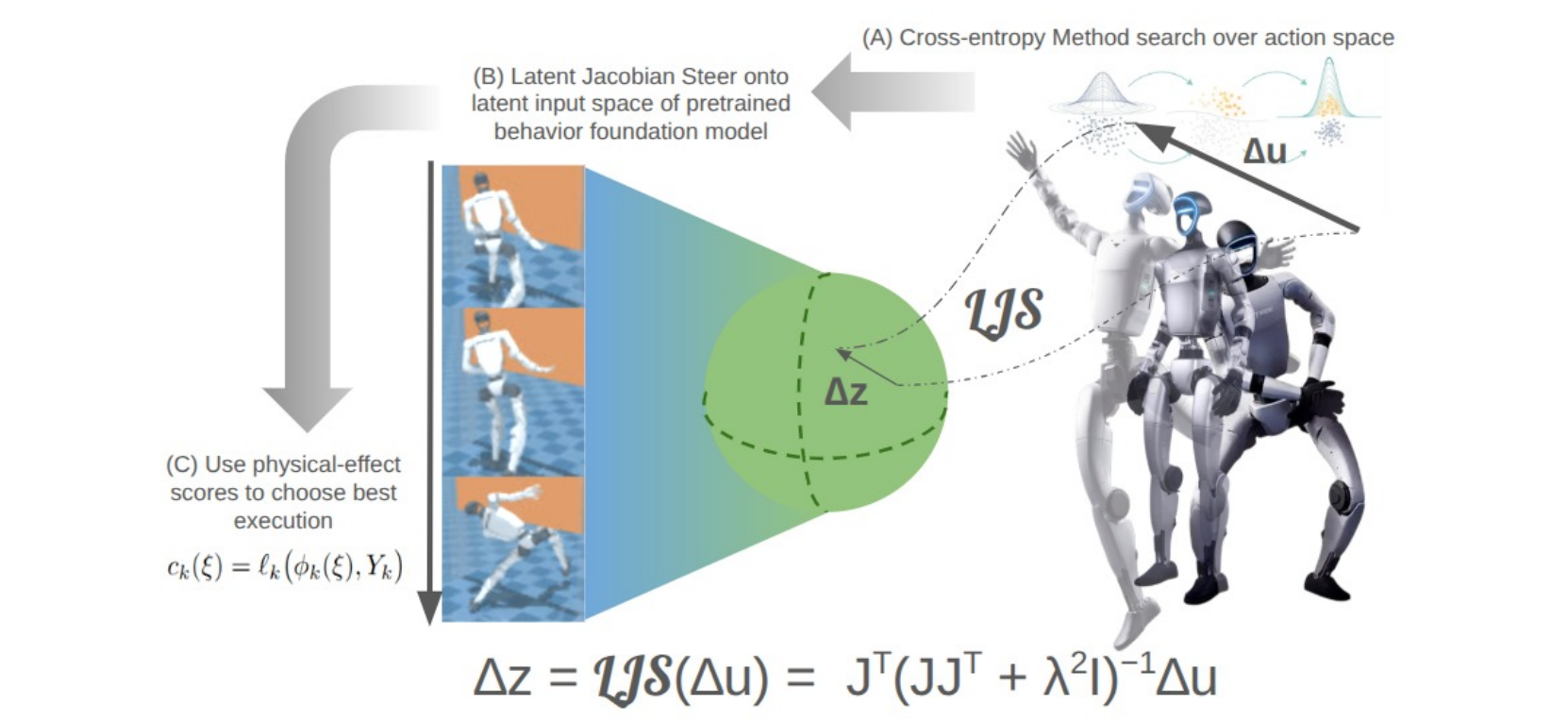
CEM samples changes to the G1 controller’s 29 joint targets. Simulated outcomes rank these proposals, and the strongest candidates guide the next round of sampling.
A damped inverse of the policy Jacobian maps each proposal into a 256-dimensional latent change. The updated command is normalized for execution through the frozen controller.
Using live observations, the frozen policy generates each rollout. Search executes the best valid command and replans from the new state until the physical effect is achieved.
Here, J is the local policy Jacobian with respect to the latent command, λ controls damping, and Δu is the proposed joint-action perturbation.
A small latent change can move some combinations of joints strongly and others barely at all. Even searching the Jacobian’s own 29-dimensional latent subspace leaves this imbalance intact. LJS starts with comparable action changes and uses the local inverse to account for the controller’s sensitivity.
Write the policy Jacobian as J = UΣVT, with singular values si. For equal-variance Gaussian proposals with variance σ2, the local action variance along direction i is:
Exploration is dominated by directions to which the controller is most sensitive.
When si is large relative to λ, the variance approaches σ2. Damping suppresses weakly responsive directions.
LJS therefore gives realizable action directions comparable exploration while limiting excessive latent changes. These directions can combine multiple joints. The argument concerns the policy’s local response; simulator rollouts determine which proposals produce useful contact-rich motion.
Tasks are specified through ordered physical effects, such as establishing support, raising an object, or clearing an obstacle. Each effect has a score that guides search and an acceptance condition that determines completion. The result is a sequence of latent commands. During execution, the frozen policy continues to receive updated observations and generate joint targets, retaining its feedback response throughout the interaction.
Across ten unseen seeds, with the same effects and settings for every method, CEM-LJS gets furthest on every task, and it is the only one that gets through the shutter.
| Method | Hurdle | Shutter | Door + cube |
|---|
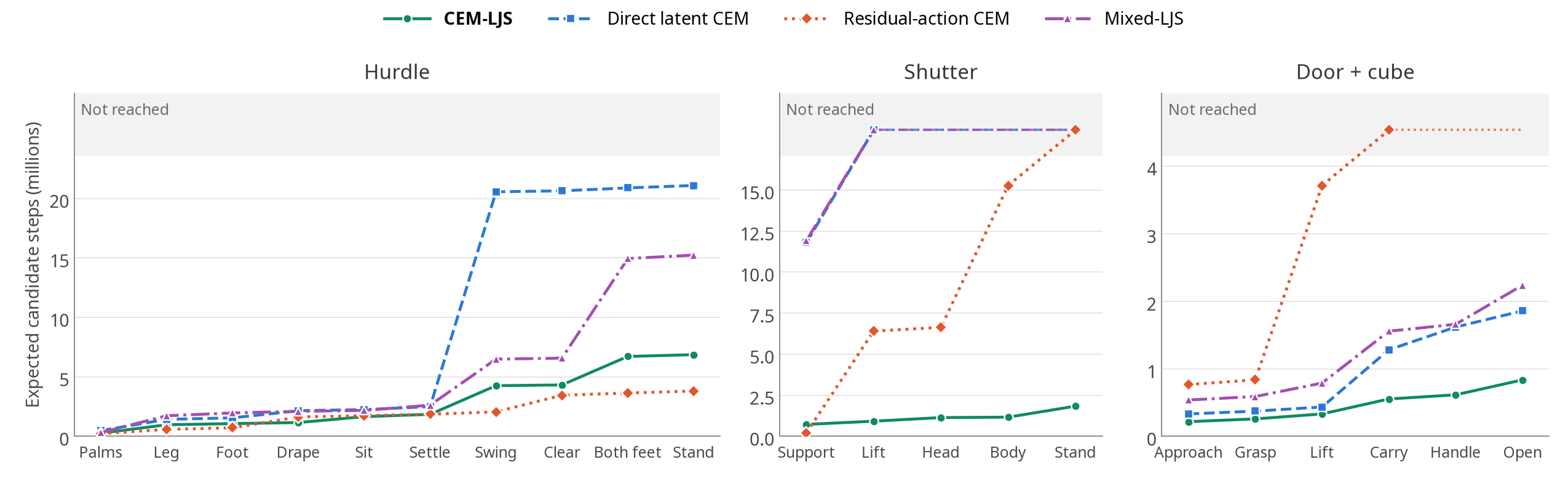
The gain comes from coupling the two spaces, not from the optimizer or from searching fewer dimensions. Steering through the Jacobian generally beats searching the latent directly, and a random latent subspace of the same size gets nowhere. Rotating the joint-action axes changes little, while searching the Jacobian’s own latent directions without the rescaling of LJS completes less than half as many tasks. No baseline gets through the shutter at any proposal scale we tried.
| Search | Shutter | Hurdle | Door + cube |
|---|---|---|---|
| Joint-action proposals through the Jacobian | |||
| CEM-LJS | 7 / 10 | 3 / 10 | 10 / 10 |
| CEM-LJS, rotated joint-action axes | 7 / 10 | 0 / 10 | 10 / 10 |
| MPPI with LJS | 4 / 10 | 2 / 10 | 9 / 10 |
| LATTICE-style LJS | 3 / 10 | 1 / 10 | 7 / 10 |
| Zero-mean refinement LJS | 2 / 10 | 1 / 10 | 2 / 10 |
| Targeted-mean refinement LJS | 1 / 10 | 0 / 10 | 4 / 10 |
| Gaussian LJS | 0 / 10 | 1 / 10 | 2 / 10 |
| Proposals in the latent space | |||
| Direct latent CEM | 0 / 10 | 1 / 10 | 6 / 10 |
| Direct latent MPPI | 3 / 10 | 0 / 10 | 6 / 10 |
| Direct latent Gaussian | 0 / 10 | 0 / 10 | 4 / 10 |
| Direct latent targeted refinement | 0 / 10 | 0 / 10 | 3 / 10 |
| Jacobian’s latent directions, without the rescaling | 3 / 10 | 0 / 10 | 6 / 10 |
| Random 29-dimensional latent subspace | 0 / 10 | 0 / 10 | 0 / 10 |
Our main tasks use detailed effect definitions. To make sure the comparison does not depend on how those are written, we also built a task whose definition leaves nothing to tune. The robot carries a 3 kg box, held between its palms, along a curve of points in 3D. Each step only asks the box to reach the next point, and the box must never touch the floor. Nothing says how to grip, lift or walk.
The three paths were generated rather than designed. Every method runs five seeds on each path and may retry a failed step from an earlier state, up to 15 minutes per run.
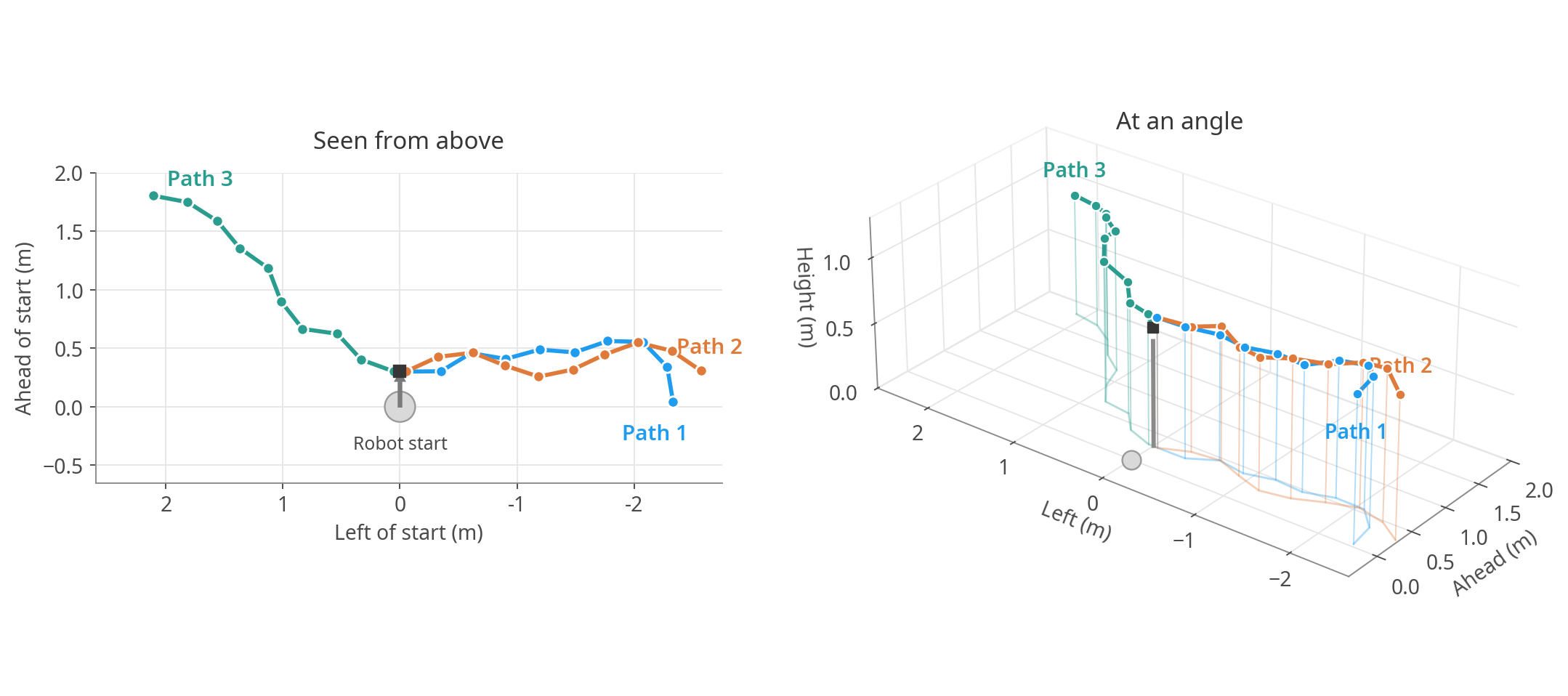
| Method | Paths completed | Points reached on average |
|---|---|---|
| CEM-LJS | 12 / 15 | 9.1 / 10 |
| Direct latent CEM | 2 / 15 | 2.5 / 10 |
| Residual-action CEM | 3 / 15 | 4.8 / 10 |
| Mixed-LJS | 1 / 15 | 1.5 / 10 |
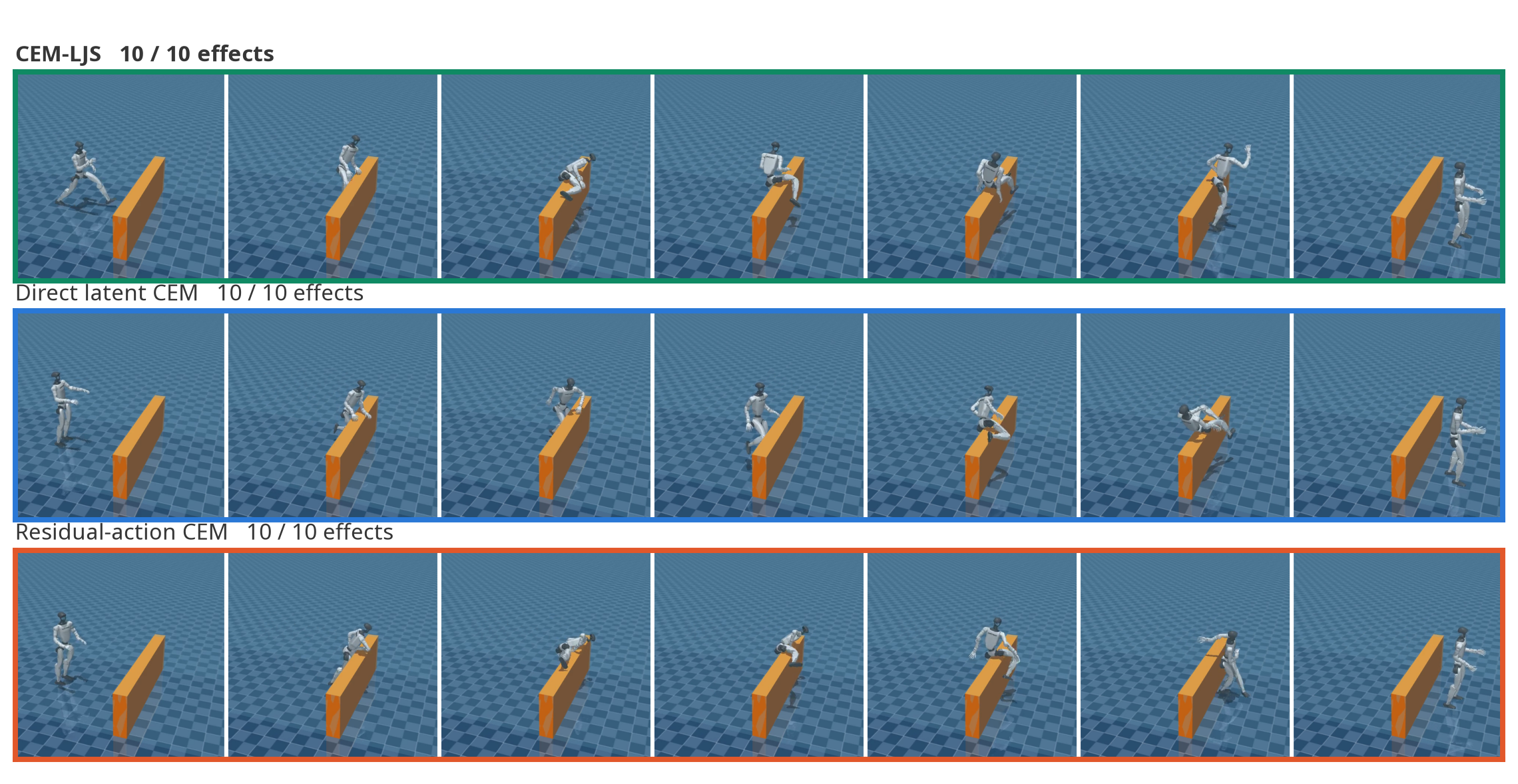
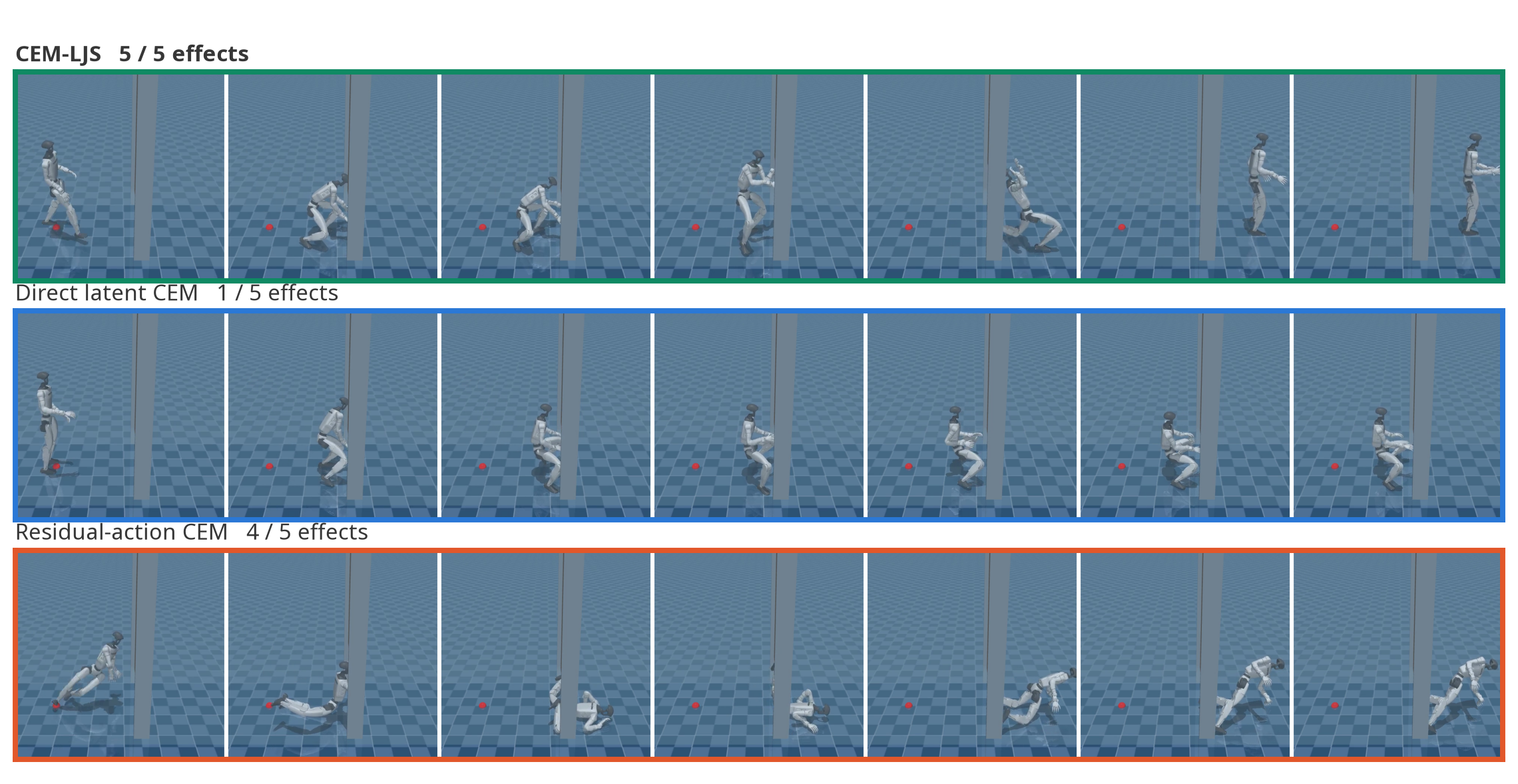
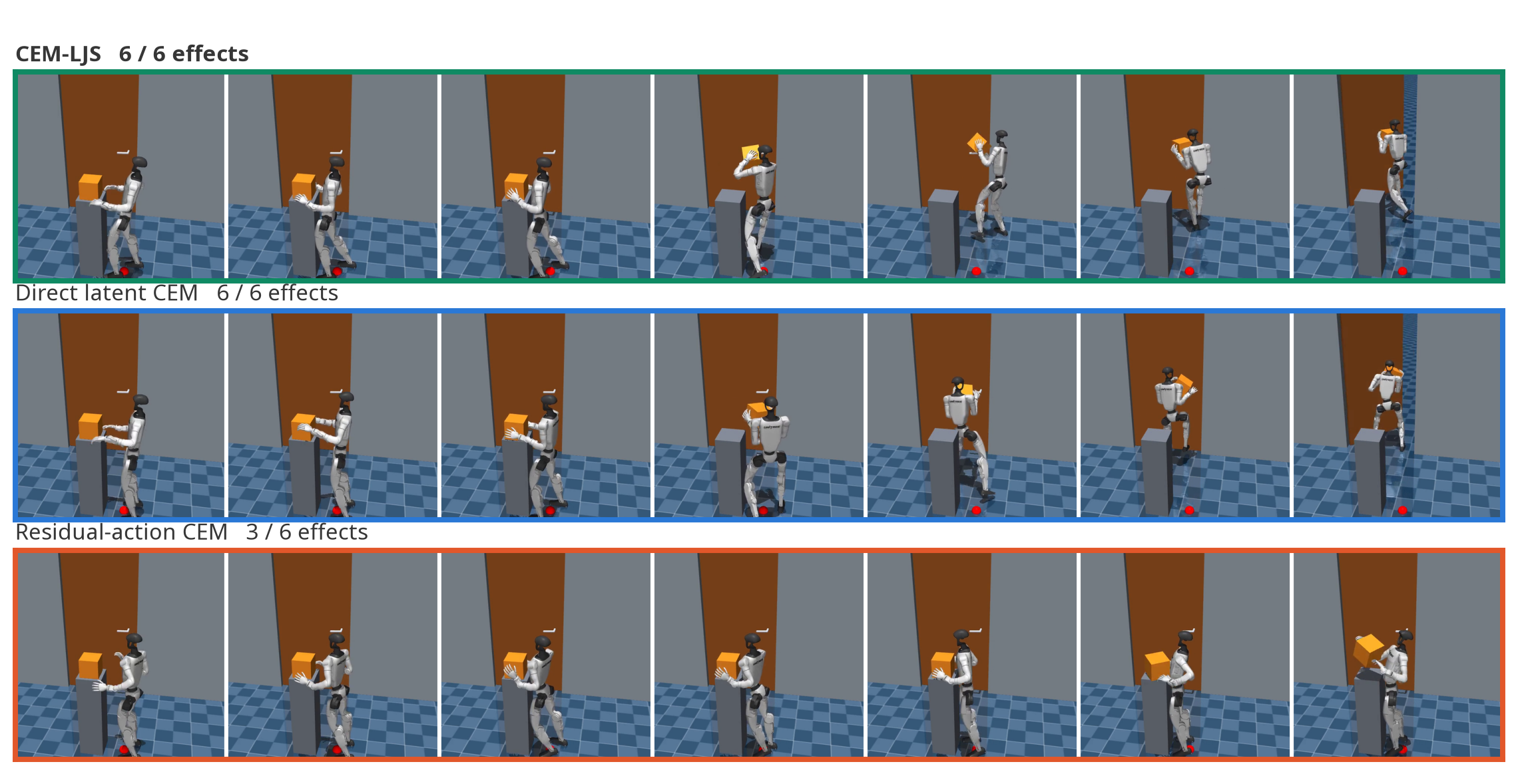
Each column shows CEM-LJS and one baseline on the same path and seed.
Precise contacts must work together with whole-body coordination. These comparisons show how each method establishes support, manipulates objects, and moves through the task, using the best run of each method.
Residual actions can push the robot through an effect, but they fight the coordination the controller already has. Replayed with the G1’s real joint and motor limits, CEM-LJS moves more smoothly, uses less power and slips less, and BFM-Zero’s own motion discriminator rates it as more human.
| Per effect | CEM-LJS | Residual-action CEM |
|---|---|---|
| Mechanical power W/kg | 1.6 | 2.6 |
| Joint jerk rad/s³ | 782 | 1,660 |
| Time at the torque limit | 6% | 20% |
| Foot slip under load m/s | 0.02 | 0.11 |
| Human-likeness | −0.9 | −2.4 |
Because a task is just a set of physical-effect scores, we can shape how the robot moves inside the search itself. Adding BFM-Zero’s motion discriminator to the hurdle’s scores gives a calmer, more human-like crossing, at the cost of a longer search.
| Per hurdle effect | Without | With discriminator |
|---|---|---|
| Mechanical power W/kg | 1.4 | 0.9 |
| Joint jerk rad/s³ | 841 | 633 |
| Human-likeness | −1.8 | −0.8 |
| Seeds completed | 10 / 10 | 8 / 10 |
The effect definitions don’t need retuning when the setup changes. From new starting positions and headings, CEM-LJS still gets through the shutter most of the time, while the baselines rarely do.
| Method | Full tasks completed |
|---|---|
| CEM-LJS | 8 / 10 |
| Direct latent CEM | 1 / 10 |
| Residual-action CEM | 0 / 10 |
| Mixed-LJS | 2 / 10 |
This setting is for practitioners who want success on every seed. A CEM-LJS search can occasionally settle in a poor local basin, so we retry a failed effect from an earlier state and score every candidate under varied friction, mass, motor strength and control delay. CEM-LJS then completes every task on every seed, in at most 15 minutes.
| Method | Hurdle | Shutter | Door + cube |
|---|---|---|---|
| CEM-LJS | 10 / 10 | 10 / 10 | 10 / 10 |
| Direct latent CEM | 6 / 10 | 6 / 10 | 10 / 10 |
| Residual-action CEM | 7 / 10 | 0 / 10 | 2 / 10 |
| Mixed-LJS | 2 / 10 | 3 / 10 | 10 / 10 |
| CEM-LJS mean search time | 8.0 min | 5.5 min | 2.4 min |
The same search also steers a frozen Play2Perfect hand policy to assemble, screw and insert parts, then release them in place, without fine-tuning it for any of these tasks, and does as well as or better than direct goal search on every one.
| Method | Beam, first part | Beam, second part | Screwing | Insertion |
|---|
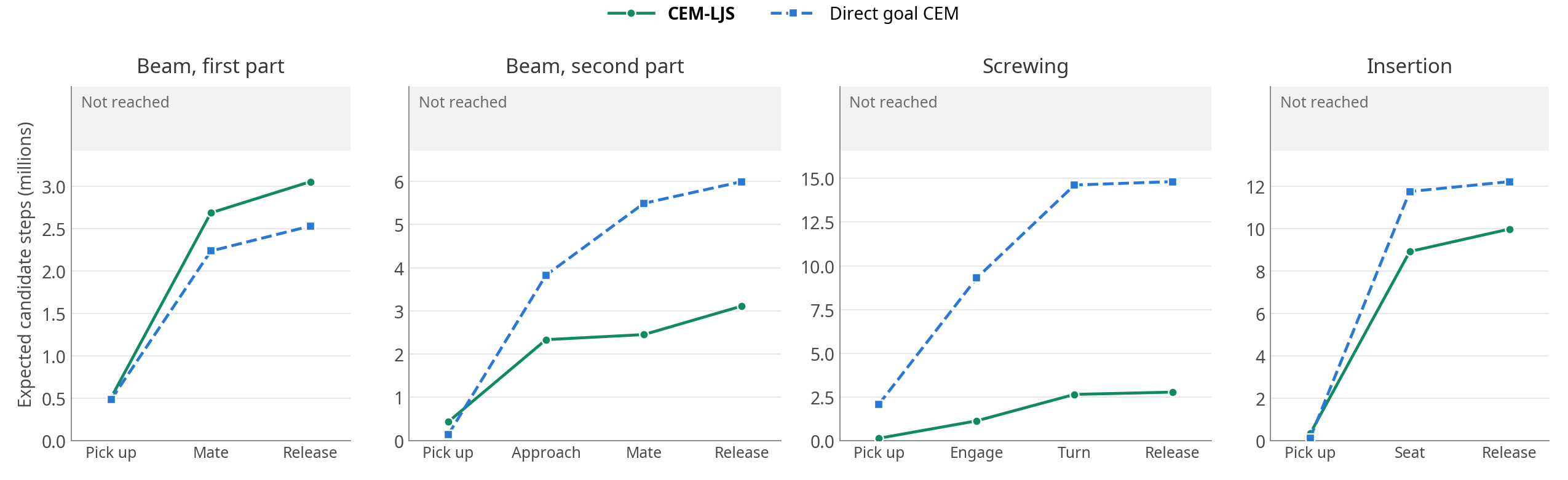
These comparisons show how each method grasps, aligns, and releases the part.
All 200 runs, ten seeds per task and method.